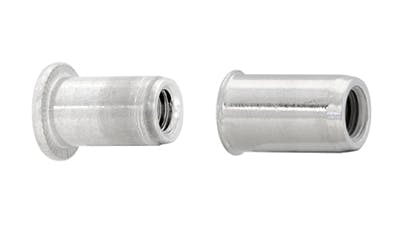
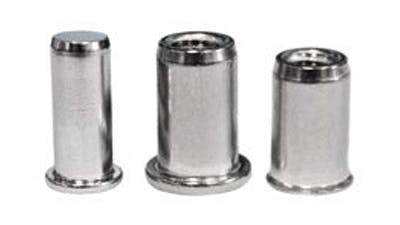
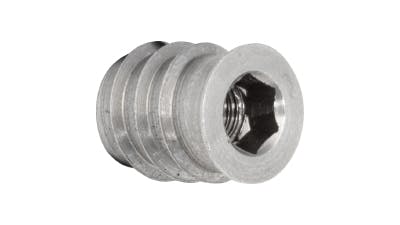
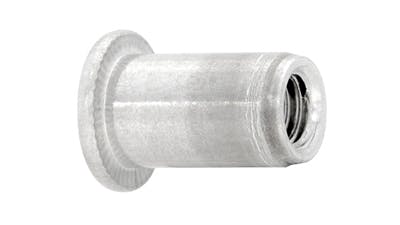
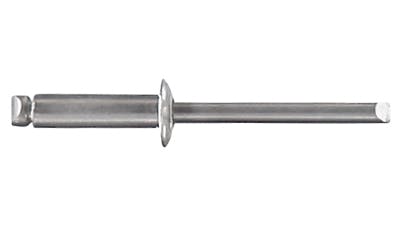
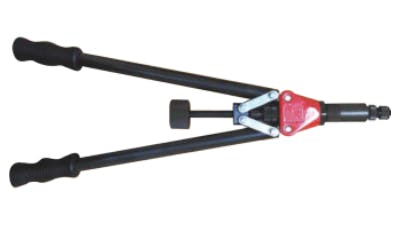
Threaded inserts are like a blind rivet with a thread at one end, the other end is either a flat flange or a small countersunk/rimless flange. The barrel in between can be crushed around sheet metal to form a nut like fixing. This can be performed by a threaded insert tool that is either hand operated or air operated (in production environments).
The sizes are denoted by the metric thread followed by the length (thickness range). This length must match the thickness of the sheet metal you are using. The length is also often referred to as the draw or grip thickness.
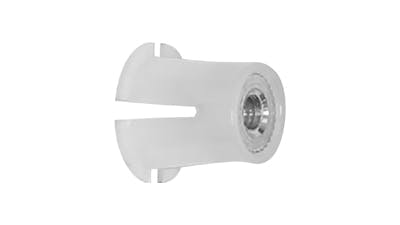
The large flat flanged range is called a Flanged Threaded Insert and the smaller countersunk type is called Rimless Threaded Insert due to its very small top flange. Both styles are available as stainless steel threaded inserts and aluminium threaded inserts. The Flanged style is also available Nylon Threaded Insert with a nylon body fitted with an aluminium threaded portion. Other materials are also available on request.
Special tools and drilling is required to fit the Threaded Insert. Care and attention should be taken to ensure the correct use of the tool; staff can supply you with an instruction manual.
Inserts may rotate after being done up, especially if the fastening seizes in the thread, the use of a lubricant will help to avoid this.
For dimensions and performance data click here
For Australian customers - see also Stainless Steel Nutserts Australia
Our Wellington Branch is Moving!
Are your masonry anchors seismically rated?
Are your chemical injection mortars seismically rated?
Super Duplex (2507 SS) Fasteners for Building & Construction
To receive useful info and product updates add your details below

Request a copy of our Engineering & Marine, or Construction Wall Chart.

If you work off-line, download a PDF of one (or both) of our paper based catalogues.
Includes a barcode scanner to make it easy to order from your phone.
Copyright 2019. All rights reserved.